Chapter 9/10A Muscles and Muscle Tissues

____________________________________________________
Learning Outcomes
LO 9.4.3 Describe the steps of a cross bridge cycle. 9.5Temporal summation and motor unit recruitment allow smooth, graded skeletal muscle contractions LO 9.5.1 Define motor unit and muscle twitch, and describe the events occurring during the three phases of a muscle twitch. LO 9.5.2 Explain how smooth, graded contractions of a skeletal muscle are produced. LO 9.5.3 Differentiate between isometric and isotonic contractions. 9.6ATP for muscle contraction is produced aerobically or anaerobically LO 9.6.1 Describe three ways in which ATP is regenerated during skeletal muscle contraction. LO 9.6.2 Define EPOC and muscle fatigue. List possible causes of muscle fatigue. 9.7The force, velocity, and duration of skeletal muscle contractions are determined by a variety of factorS 9.7.2 Describe three types of skeletal muscle fibers and explain the relative value of each type. 9.8How does skeletal muscle respond to exercise? LO 9.8.1 Compare and contrast the effects of aerobic and resistance exercise on skeletal muscles. 9.9Smooth muscle is nonstriated involuntary muscle LO 9.9.1 Compare the gross and microscopic anatomy of smooth muscle cells to that of skeletal muscle cells. LO 9.9.2 Compare and contrast the contractile mechanisms and the means of activation of skeletal and smooth muscles. LO 9.9.3 Distinguish between unitary and multi unit smooth muscle structurally and functionally.
____________________________________________________
____________________________________________________
Learning Outcomes
- 9.1There are three types of muscle tissue
- LO 9.1.1 Compare and contrast the three basic types of muscle tissue.
- LO 9.1.2 List four important functions of muscle tissue.
- 9.2A skeletal muscle is made up of muscle fibers, nerves, blood vessels, and connective tissues
- LO 9.2.1 Describe the gross structure of a skeletal muscle.
- 9.3Skeletal muscle fibers contain calcium-regulated molecular motors
- LO 9.3.1 Describe the microscopic structure and functional roles of the myofibrils, sarcoplasmic reticulum, and T tubules of skeletal muscle fibers.
- LO 9.3.2 Describe the sliding filament model of muscle contraction.
- 9.4Motor neurons stimulate skeletal muscle fibers to contract
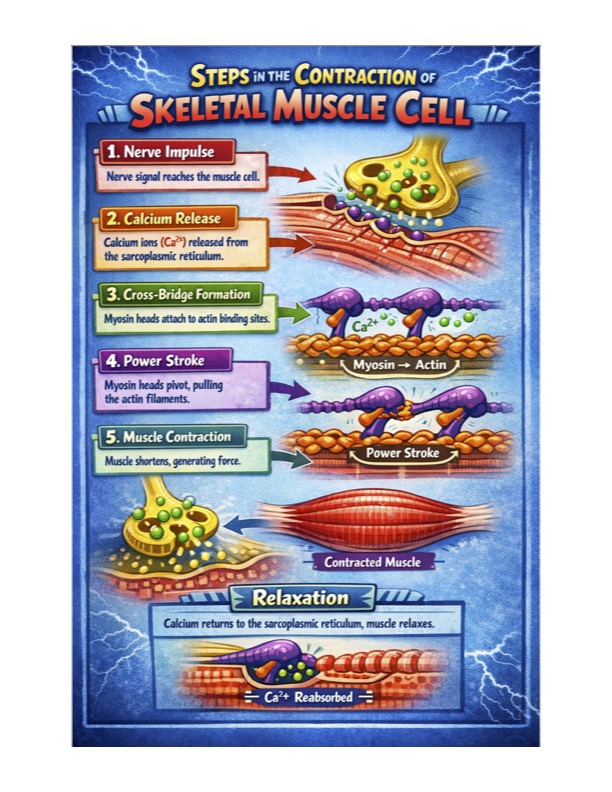
- LO 9.4.1 Explain how muscle fibers are stimulated to contract by describing events that occur at the neuromuscular junction.
- O 9.4.2 Follow the events of excitation-contraction coupling that lead to cross bridge activity.
____________________________________________________
Notes part A
Notes part B
Notes part C
10A
Knowledge sheets
Answers
Workbook
Answers
________________________________________________________________
_________________________________________________________________________________________________________________________________________________